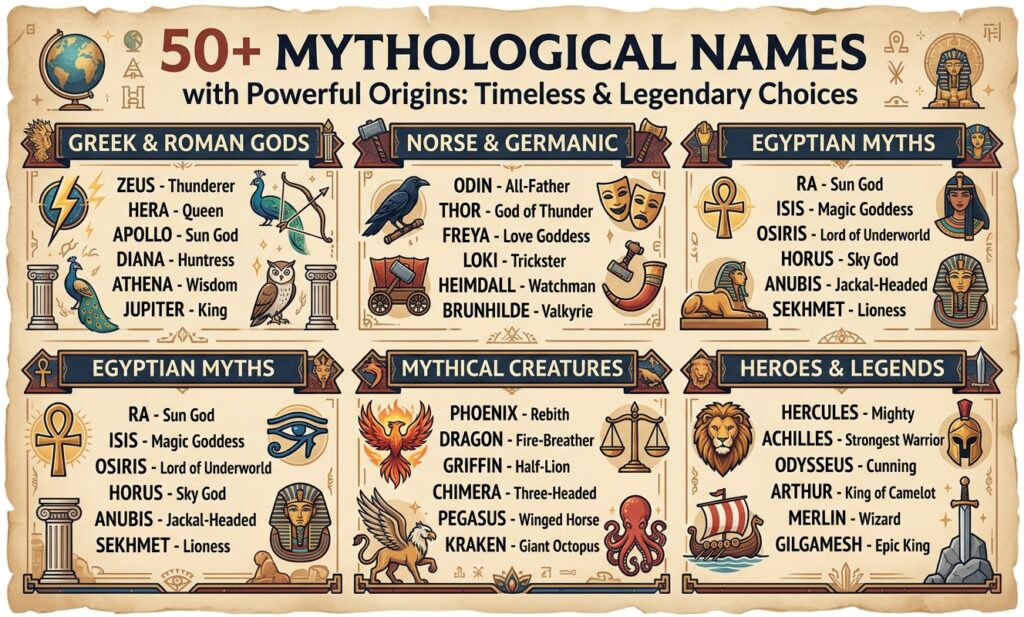
Mythological names carry stories that have survived for thousands of years. Each one comes from a god, hero, or legend that once shaped how people saw the world. Choosing a mythological name gives a child a link to something ancient and powerful.
Every culture has its own myths, and each myth gave birth to names full of meaning. These names often stand for strength, wisdom, beauty, or courage. That is why so many parents today still turn to mythology when picking a name.
A name can shape how a child feels about themselves as they grow. A strong, meaningful name can give a quiet sense of pride. This list of mythological names brings together legends from many cultures in one place.
10 Timeless Greek Mythological Names and Meanings
- Athena – Means goddess of wisdom and war.
- Apollo – Means god of the sun and music.
- Hera – Means queen of the gods.
- Perseus – Means hero who slayed Medusa.
- Persephone – Means goddess of spring and the underworld.
- Achilles – Means near invincible Greek warrior.
- Helena – Means the most beautiful woman in Greek myth.
- Orion – Means great hunter placed among the stars.
- Selene – Means goddess of the moon.
- Theodora – Means gift of the gods.
10 Strong Norse Mythological Names and Their Origins
- Odin – Means all-father, ruler of Asgard.
- Freya – Means goddess of love and beauty.
- Thor – Means god of thunder and strength.
- Loki – Means trickster god of mischief.
- Sigrid – Means beautiful victory.
- Bjorn – Means bear, symbol of strength.
- Astrid – Means divinely beautiful.
- Baldr – Means god of light and purity.
- Freyr – Means god of peace and fertility.
- Idunn – Means goddess who guards eternal youth.
10 Celtic and Irish Mythological Names with Deep Roots
- Brigid – Means exalted goddess of fire and poetry.
- Aoife – Means beauty, fierce warrior queen.
- Finn – Means fair, legendary Irish hero.
- Niamh – Means bright or radiant.
- Cormac – Means charioteer, son of a king.
- Etain – Means shining one from Irish legend.
- Lugh – Means god of skill and light.
- Maeve – Means she who intoxicates.
- Oisin – Means little deer, warrior poet.
- Rhiannon – Means great queen, Welsh mythological figure.
5 Egyptian Mythological Names Full of Mystery
- Isis – Means goddess of magic and motherhood.
- Anubis – Means god of the afterlife.
- Osiris – Means god of the underworld and rebirth.
- Nefertari – Means beautiful companion.
- Horus – Means sky god, protector of kings.
5 Hindu Mythological Names with Divine Meanings
- Arjun – Means bright, shining warrior prince.
- Saraswati – Means goddess of knowledge and arts.
- Kavya – Means poetry, filled with grace.
- Indra – Means king of the gods and sky.
- Lakshmi – Means goddess of wealth and fortune.
5 Rare Mythological Names from Around the World
- Xochitl – Means flower, Aztec goddess symbol.
- Amaterasu – Means Japanese sun goddess.
- Quetzal – Means feathered serpent god from Aztec myth.
- Inari – Means Japanese god of rice and prosperity.
- Coyolxauhqui – Means Aztec moon goddess.
5 Gender-Neutral Mythological Names with Strong Meanings
- Phoenix – Means mythical bird reborn from ashes.
- Ash – Means sacred tree in Norse mythology.
- River – Means sacred waters honored in many myths.
- Sage – Means wise one, linked to ancient wisdom.
- Storm – Means power of thunder gods across cultures.
Frequently Asked Questions
What are the most popular mythological names for babies?
Some of the most popular mythological names include Athena, Odin, Freya, and Phoenix. These names are loved for their strong meaning and timeless appeal.
Are mythological names good for both boys and girls?
Yes, many mythological names work well for boys, girls, or as gender-neutral choices. Names like Phoenix, Ash, and River suit any child.
Where do most mythological names come from?
Most mythological names come from ancient cultures like Greek, Norse, Egyptian, Celtic, and Hindu mythology. Each culture created names tied to gods, heroes, and legends.
Do mythological names have deep meanings?
Yes, mythological names almost always carry deep meanings tied to power, wisdom, beauty, or courage. This is part of why they remain popular even today.
Why do parents choose mythological names for their children?
Parents often choose mythological names because they feel unique, strong, and rich in history. These names also give a child a story to grow into.
Conclusion
Mythological names bring together thousands of years of stories, gods, and legends. From Greek heroes to Norse gods and Hindu deities, this list offers choices for every taste. Each name carries a piece of history that can stay with your child for life.
Feel free to share this list of mythological names with friends and family who are also searching for the perfect name. A name rooted in legend can become a lifelong source of pride. We hope you found a name here that truly feels timeless.